Brazil's 2027 VAT reform: revenue-neutral against which year?
Brazil’s tax reform is neutral against a ten-year average. Nobody sees or feels an average.
In the budget it sent to Congress in August 2026, Brazil’s federal government projects R$750.4 billion in revenue in 2027 from federal taxes on consumption, which today are the PIS and Cofins contributions and the IPI excise tax. For 2026, the projection is R$630.2 billion.1 That is 19% more, in a year in which the economy, in current prices, is expected to grow 8%, according to the same budget. It is the first budget of a reform that, in the words of the Finance Ministry, “was conceived on the assumption that there will be no increase in the tax burden.”2
Incredibly, both things are true, and what reconciles them is an average. The law requires preserving the tax burden of a decade, 2012 to 2021, when more was collected than today. The government speaks of “replacing the exact loss of revenue,” a total in which the increases of some are offset by the reductions of others.2 And the effect on prices is usually measured by an inflation index, which condenses hundreds of prices into one number. In every case, the reform looks neutral, or nearly so. But nobody sees or feels an average: a company compares January’s tax bill with December’s, and a family compares this month’s bill with last month’s.
Seen up close, the differences are large: the federal burden on consumption rises between 8% and 11%, and the federal tax on the revenue of a group of companies that employs about 3 million people increases, at the statutory rate, by about 50%. Where the client of those companies is larger than they are, who ends up with the bill depends on a negotiation that the law did not regulate. On prices, this article’s estimate is a one-time rise of 0.2% to 0.6%.
Ten years in one number
On January 1, 2027, PIS and Cofins on revenue cease to exist and the Contribuição sobre Bens e Serviços (CBS), the new federal value-added tax, takes their place.3 The rate has not been set yet: the federal audit court, the Tribunal de Contas da União (TCU), sends its calculation to the Senate by October 30, 2026, and the Senate decides by December 15 of the same year.4 The criterion, however, is already in Complementary Law 214 of 2025, which implemented the reform. The CBS, added to the Selective Tax, which will apply to products harmful to health or the environment,1 and to what remains of the IPI, must raise, as a share of GDP, the same as PIS, Cofins, IPI and the financial transactions tax (IOF) on insurance raised, on average, from 2012 to 2021.5 The methodology approved by the TCU calls that number the model’s “revenue target.”6
The sum of PIS, Cofins and IPI revenue, which the federal revenue service, Receita Federal, publishes every year, gives the measure of the target. Between 2012 and 2021 it averaged 4.98% of GDP.7 It then fell to 4.05% in 2022 and 3.91% in 2023, and returned to 4.58% in 2024.7 The budget records 4.60% in 2025 and projects 4.61% for 2026.1 The target is 0.37 percentage point of GDP above what is paid today, roughly R$55 billion a year at the GDP projected for 2027.
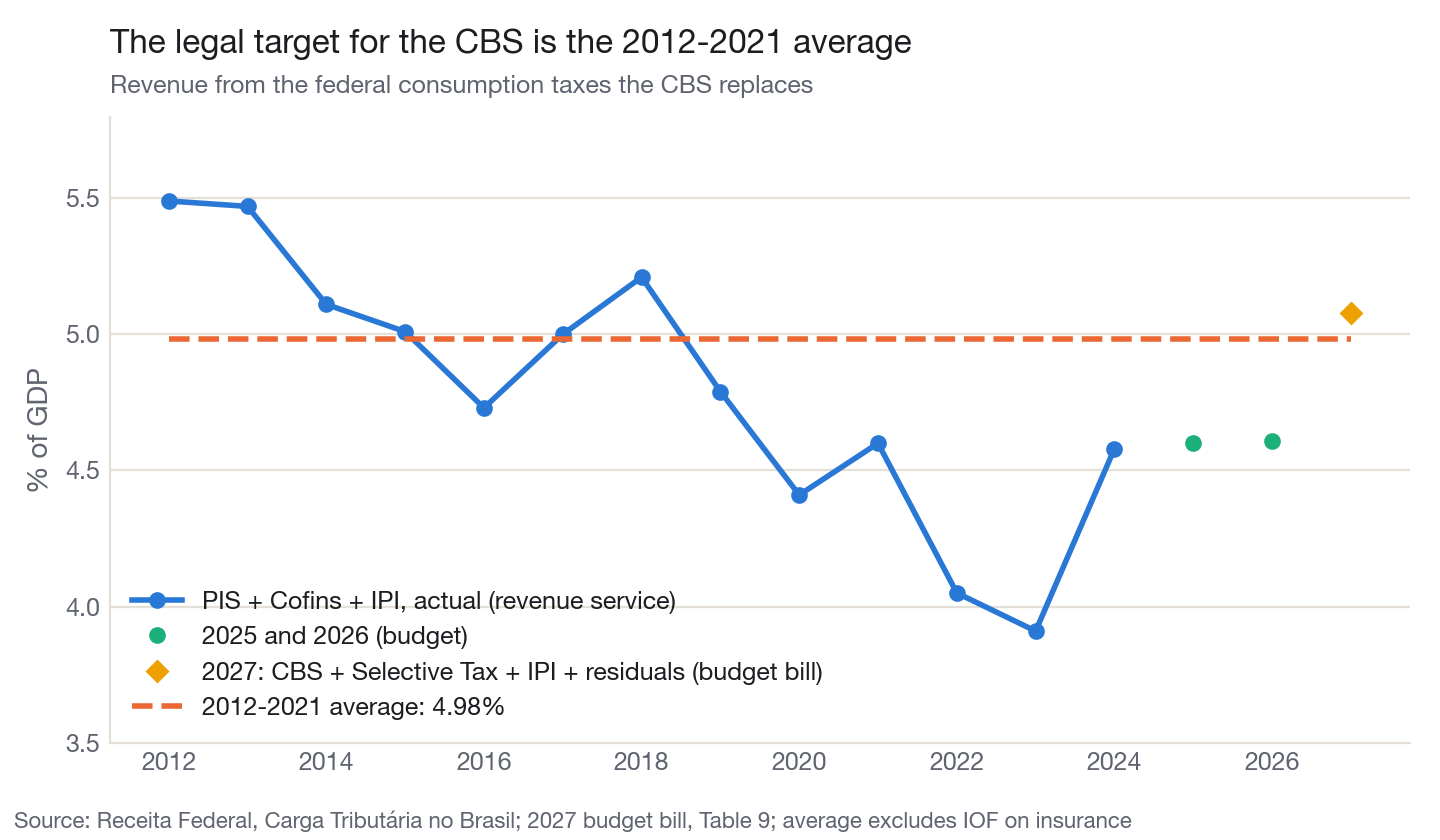
The calculation has limits: it leaves out the IOF on insurance, joins a revenue-service series to a budget series, and carries, on both sides, the part of PIS levied on payroll, which will not be abolished. The official number will come with the TCU’s calculation, but the newspaper Valor Econômico reported in September 2026 that the government is working with 5.1% of GDP, slightly above this estimate.8 With 4.98%, the increase over the 2026 burden is 8%; with 5.1%, it is 11%.
The budget’s 19% calls for care, because it mixes two things. A company with revenue of R$2,000 in 2026 pays R$92 in these taxes, if it follows the proportion of the country as a whole. In 2027, with the economy growing 8% in current prices, its revenue is R$2,160. If the tax weighed the same, it would pay R$100; the budget projects the equivalent of R$110. Of the R$18 difference, R$8 simply follows the higher revenue, and the other R$10 is additional tax: 10% above what the company would pay under today’s rules, within the 8% to 11% range that the target implies.
The news site Contábeis, reporting the jump in September 2026, attributed it in part to an overlap between the old system and the new one, since in 2027 the government still collects R$66.1 billion in PIS and Cofins, alongside R$636.8 billion in CBS, R$42.0 billion in Selective Tax and R$5.5 billion in IPI.19 The most likely reading, which the budget does not spell out, is that nobody pays twice. Part of that residual is the PIS levied on payroll, which continues to exist. The rest is the last month of the old taxes, paid in January, as happens to someone who switches phone carriers at the turn of the year: the last bill from the old one still falls due, and the first from the new one only arrives in February. Over the year, 12 bills are paid, one from the old carrier and 11 from the new. If that reading is right, the revenue, which the budget puts at 5.08% of GDP in 2027, should hold in 2028 and the years after.
The choice of the decade can be defended, since a long period avoids locking in a bad moment for public finances. In 2022 and 2023, revenue was depressed by fuel tax relief and by cuts to the IPI, which the revenue service itself cites when explaining the recovery of 2024.7 In 2025 and 2026, however, with that relief gone, the burden stayed at 4.6% of GDP. That is the level companies start from, and none of them remembers what it paid, on average, between 2012 and 2021.
The same decade reappears where there should be a brake. The ceiling written into the Constitution only lowers the rate in 2030, looking at 2027 and 2028, and compares the result with the revenue of 2012 to 2021; since the target is already that, it offers no protection against the increase relative to today.10 The tax base, for its part, starts from what taxpayers declared in 2024 and 2025, already net of evasion: if automatic collection at the moment of payment reduces evasion, the same rate will raise more.6
Who is above and who is below
An increase of 8% to 11% is itself an average, and few companies sit on it.
Two models of PIS and Cofins coexist today. Under the cumulative one, a company pays 3.65% of its revenue and deducts nothing. Under the non-cumulative one, it pays 9.25% and deducts credits on part of what it buys.11 Companies under lucro presumido, the simplified way of computing corporate income tax, open to those with revenue of up to R$78 million a year, are in the first; those under lucro real, the full accounting regime, are as a rule in the second.11 Simples Nacional, the regime for the smallest companies, continues to exist with its own rules. The CBS ends the division for the rest, which fall under what the law calls the regular regime: all of them pay the same rate, with credit on practically everything they buy from another taxpayer.12 Private estimates put that rate between 8.8% and 9.4%; this article uses 9.33%: the only point estimate located, 9.43%, from the consultancy Roit, less the 0.1 percentage point that the law deducts in 2027 and 2028.4 The Imposto sobre Bens e Serviços (IBS), the state and municipal half of the new tax, only begins to replace the state sales tax (ICMS) and the municipal services tax (ISS) in 2029, so in 2027 only the federal tax changes.3
For those already paying 9.25%, the switch tends to be favorable. Models built by two law firms with their clients’ data, released in July 2026, estimate that a company under lucro real goes from an effective rate of 10.2%, calculated on a price that already contains the tax, to about 9%, calculated on the price without it and with more credits.13 The IPI, in addition, is set to zero for almost all products.3 For these companies, according to the models, the bill does not rise: the transition brings costs, such as the loss of part of the credit on purchases from Simples suppliers and the possibility that the CBS enters the ICMS tax base, but the effective rate falls.1415
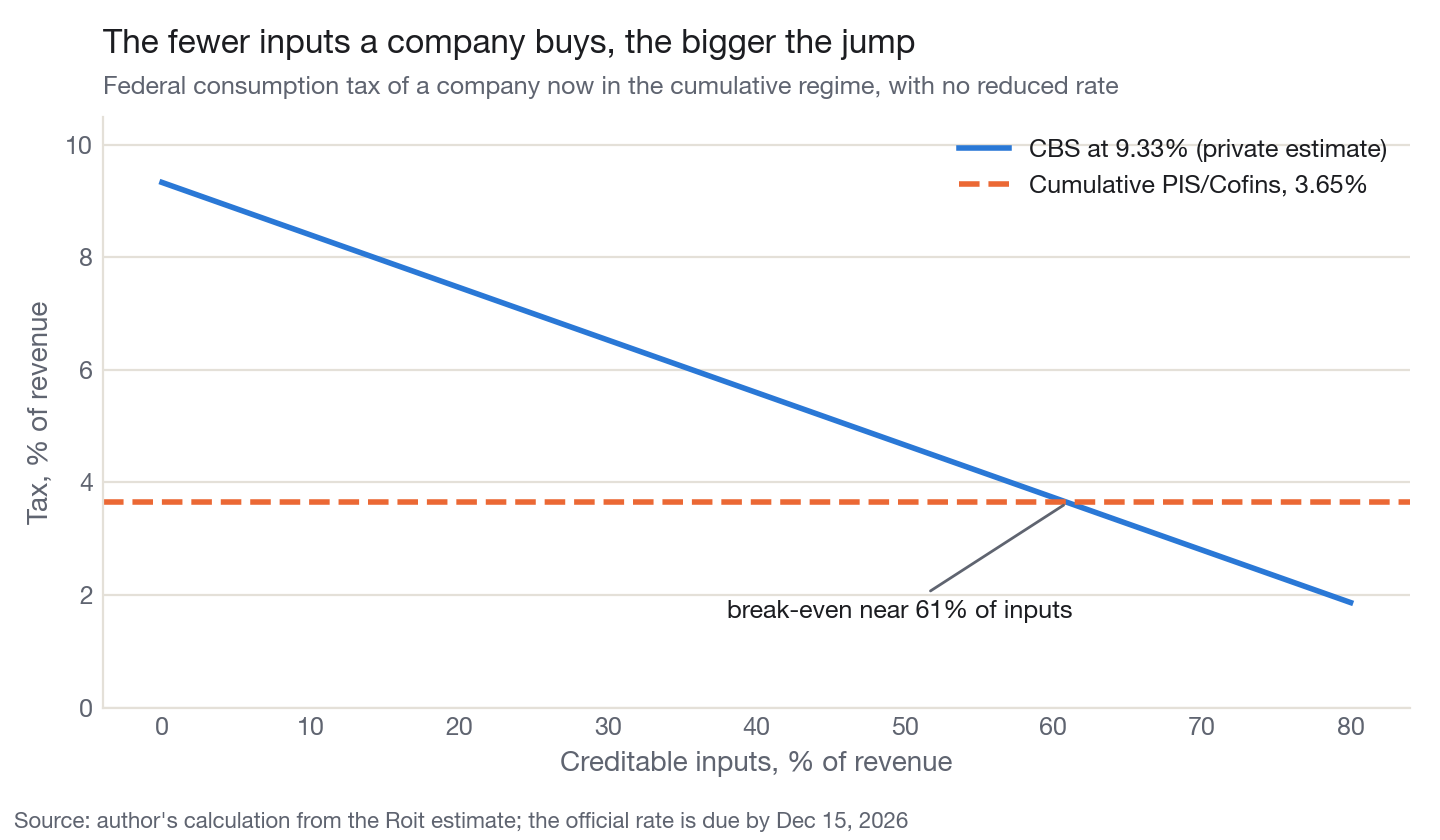
Those leaving the 3.65% regime will, in most cases, start 2027 with an increase. With a CBS of 9.33%, a company with no inputs will pay 9.33% of its revenue. Just to break even with today’s 3.65%, creditable purchases would have to reach 61% of revenue; with a rate of 8.8%, the floor of the estimates, 58.5%.
The annual services survey of the national statistics office, IBGE’s Pesquisa Anual de Serviços, makes it possible to compute, for 34 segments, intermediate consumption, the share of revenue spent on goods and services bought from third parties. In 2023, only 2 of the 34 exceeded 61%: air transport and road freight.16 Hotels and restaurants, whose rate is reduced by 40%, break even at about 35% and also escape.17 For services as a whole, intermediate consumption was 41.9%, and at the other end were the activities whose product is people: staffing agencies, at 12%; security, at 16%; cleaning and building services, at 17%.
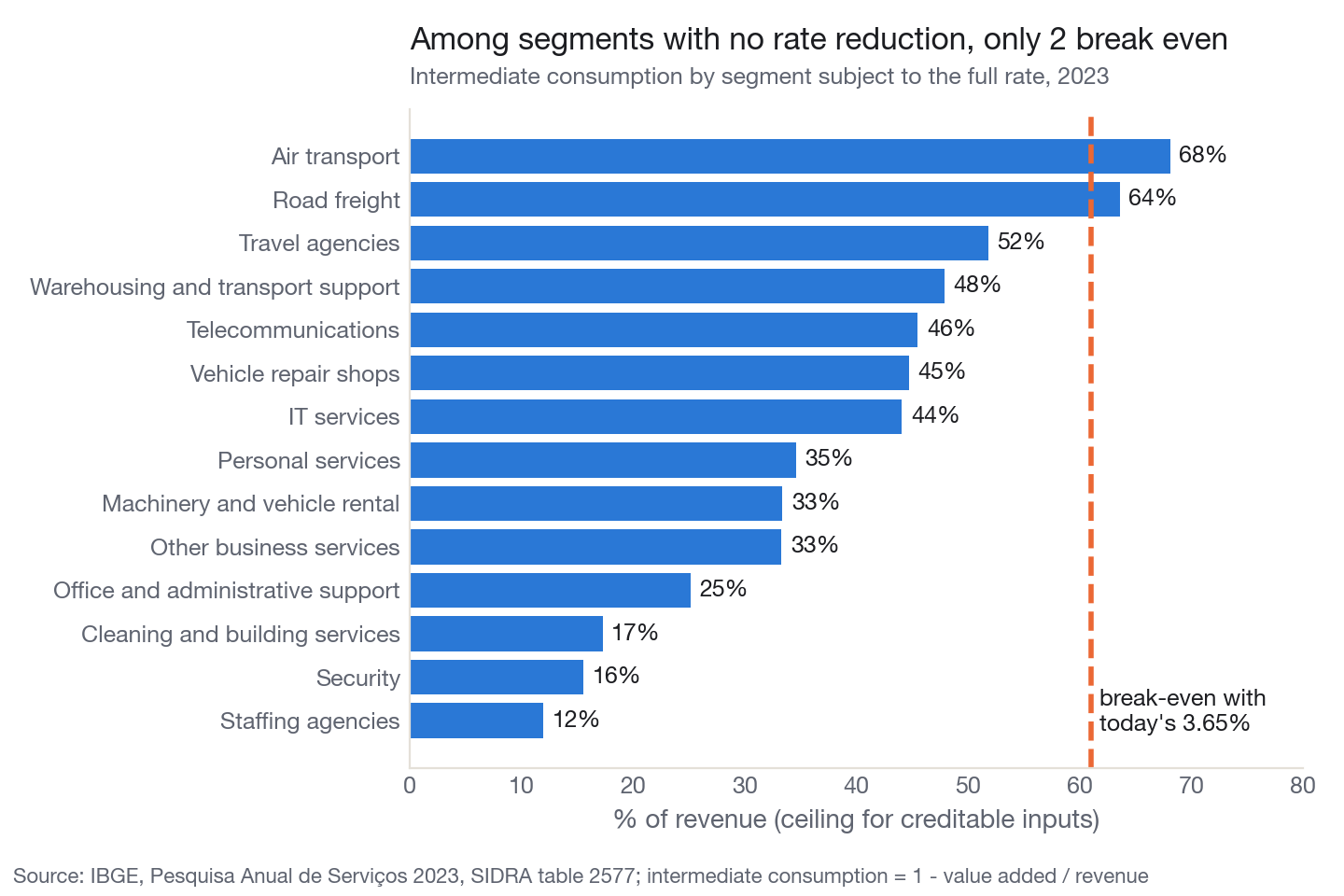
Being far from break-even only matters for those paying 3.65% today, and that group has two parts. The first is services under lucro presumido. The second is under lucro real: the laws that created the 9.25% regime kept at 3.65%, whatever the way of computing income tax, private security companies and the revenue from telecommunications, from a good part of IT services, from call centers and from construction, among others.11 Cleaning and staffing agencies are not on that list; the large companies in those two sectors therefore stay in the 9.25% regime, and for them, by deduction, the CBS changes little.
With the revenue service’s Dados Setoriais 2024, which refer to 2023, it is possible to estimate how many companies will pay more, after applying the rate reductions and removing the special regimes.18
| Part of the group | Companies | Employees |
|---|---|---|
| Services under lucro presumido | 243,000 | 1.5 million |
| Lucro real kept at 3.65% (security, telecommunications and IT services, the last counted in full) | 7,500 | 1.6 million |
| Total | about 250,000 | 3.1 million |
The value added of this group is equivalent to about 5% of GDP. The tax increase, brought to 2027 values, ranges from R$20 billion, with a CBS of 8.8%, to R$24 billion, with 9.33%, which is 44% to 52% above what the current rule charges these companies. That accounts for about two fifths of the R$55 billion increase in the burden. It was not possible to identify who pays the rest; call centers and construction, which the revenue-service data do not allow to be separated, are probably part of the answer.
The group is larger than the government admitted and much smaller than “the services sector.” In 2023, Bernard Appy, then the Finance Ministry’s special secretary for the tax reform, calculated that the segment harmed was “absolutely residual,” 1.3% of GDP.19 His measure is narrower than this article’s, because it excludes services sold to companies that use the credit. In the same year, the national confederation of commerce and services (CNC) publicized an average increase of 84% in the burden of 30 segments of a sector that, in 2025, made up 69.5% of the country’s value added.2021
What unites this group is selling labor, and the reason it pays more does not lie in a flaw of the tax. A value-added tax is levied on what a company adds to what it bought, which is wages plus profit; giving credit for payroll would mean taxing profit alone.12 The problem is what Brazil already charges on the same base. A services company with revenue of R$100 that spends R$60 on wages and R$20 on inputs pays, on the wages, R$12 in employer social security contribution, which is 20% of payroll.22 On the sale, it pays R$3.65 in PIS and Cofins today; with a CBS of 9.33% on the R$80 left after inputs, it will pay about R$7.50. The sum goes from R$15.65 to about R$19.50 for every R$100 sold, without the company having hired or sold more.
Hiring the worker as a contractor frees the company from the payroll contribution but does not reduce the CBS, because the invoice of a Simples supplier only gives credit “in an amount equivalent to that due under that regime.”12
The full rate this group pays carries, in turn, the weight of the exceptions. The official estimate for the standard rate of the complete tax, with the IBS, was 26.5%;23 in August 2024, the Finance Ministry calculated that the changes made in the lower house added 1.47 percentage points, of which 0.56 percentage point came from including meat in the basic food basket.2 The law, signed in January 2025, has 13 categories with a 60% reduction, 18 professions with a 30% reduction and 8 categories at a zero rate, and the 26.5% limit it sets merely obliges the executive to send a bill to Congress if the rate exceeds it.17 Health and education are on the 60% list; security, cleaning and staffing agencies are on no list at all.17
What reaches prices
The inflation index is also an average, and the one most generous to the reform.
If the federal burden on consumption rises 0.37 percentage point of GDP, someone pays. Assuming the increase falls on household and government consumption, the impact on the price level is between 0.22%, if half is passed on, and 0.45%, if pass-through is complete. If it falls on households alone, since the law seeks to keep the burden on public purchases constant, the ceiling rises to 0.58%. None of the official documents consulted contains this calculation. The effect happens once and prices stay at the new level, which distinguishes it from an inflation that feeds on itself.
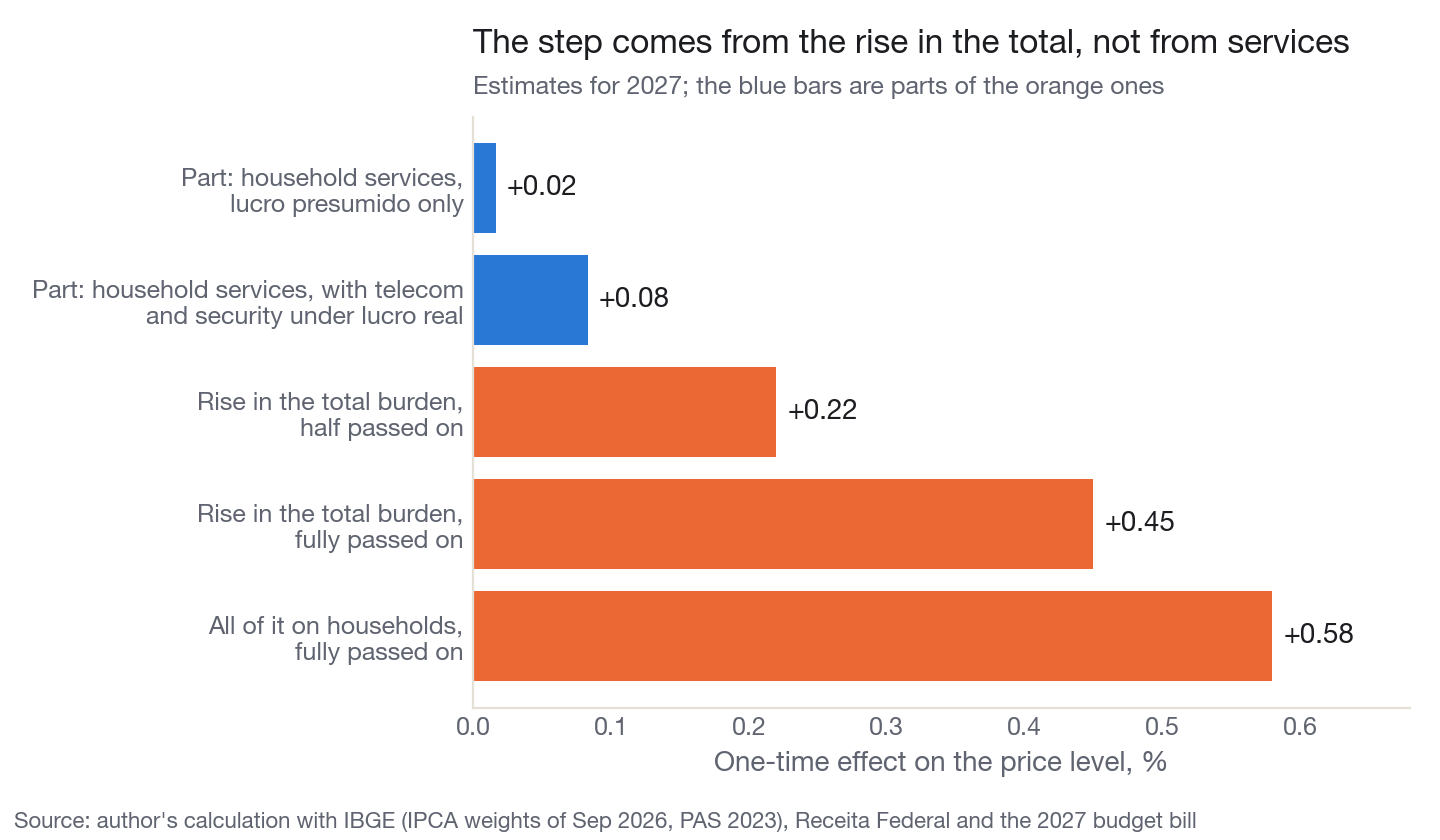
Within that step, the part that comes from services consumed by households is small. For 13 groups of services in the September 2026 consumer price index (IPCA), the part of the tax increase that reaches the price, with complete pass-through, is equivalent to 0.08% of the index.24 The services that weigh on household budgets are barely in the affected group: eating out, doctors, schools, hotels and cinemas have reduced rates that cancel the increase; health plans and public transport have their own regimes in the law; residential rent and domestic workers are not sold by companies in this group; and at the hairdresser, the repair shop and the gym, less than a fifth of revenue is in companies under lucro presumido.1718
The step may be larger than this calculation indicates. It works with the net increase of R$55 billion and assumes that companies in the 9.25% regime, if they do pay less, pass the reduction on to their prices. If they do not, what reaches the consumer is the increase of those who pay more, without the offset. In 2021, analyzing an earlier bill, with a CBS of 12% and without the exceptions of the current law, the Economy Ministry concluded that the change “will not bring about a systematic rise in prices” and calculated a fall of 0.05 percentage point in the IPCA if increases and reductions were passed on equally.25 The same note records a rise of 0.99 percentage point for the case in which only the increases are passed on.
The economic literature calls this phenomenon asymmetric incidence, and a well-documented case is that of Finland’s hairdressers. In 2007, the country cut the tax on the service by 14 percentage points, and six in ten salons kept their prices; in 2012, it restored the 14 points, and about half passed the whole increase on.26 The authors of the study found the same pattern in tax changes across the European Union between 1996 and 2015. Not all studies agree: an IMF paper on the euro area found no difference between increases and reductions, and another, on German supermarkets, found the opposite.2728
A step of 0.2% to 0.6% in the index, in any case, does not describe what happens in each contract. A service provider that goes from 3.65% to more than 7% of its revenue, in a sector where payroll is between 60% and 80% of costs, tends to pass the difference on, and the outcome depends on who is on the other side.29
| The provider’s client | Uses the CBS credit? | What happens to the increase |
|---|---|---|
| Company in the regular regime | Yes | Pays more on the invoice and recovers all of it; net cost tends to fall |
| Government | No | The law reduces the rate on these sales and provides for rebalancing the contract |
| Household, condominium, nonprofit, Simples company | No | Is passed on in the price |
In sales to the government, the law created a reducer on the rate, calculated to keep the 2024 and 2025 burden on public purchases, and a procedure for rebalancing contracts.30 The reducer preserves the government’s spending, not each supplier’s margin, and does not apply to Simples suppliers.30 In the data available, which are old, the public sector was the largest client of outsourcing: about 60% of the cleaning market in 2011 and more than half of private security purchases in 2016.31
In the third case are the prices that the index dilutes. In condominium fees, assuming half of the fee pays for services contracted from companies in the 3.65% regime, the tax increase is equivalent to about 2% of the fee; in telephony, where almost all revenue is in lucro real companies kept in that regime, it is equivalent to about 1.4% of the bill.18
That leaves the first case, the client that takes the credit, and there the government is right to say that mid-chain services benefit:19 today the 3.65% embedded in the price of services such as cleaning and security generally gives the client no credit, and the CBS will.32 But a contract between private companies depends on negotiation, because the law says the chapter on rebalancing “does not apply to private contracts.”30
That is what a small services company, under lucro presumido and with costs almost entirely in payroll, is living through today; its main client is a large company in the trade sector, under lucro real. In 2026, the client began asking all its suppliers for discounts on the argument that the reform will raise its taxes, which the models cited above do not confirm for a company in its position. The provider, which will see the federal tax on its revenue go from 3.65% to about 9%, needs the opposite: a higher invoice.
In a R$100 contract, the provider keeps R$96.35 today after PIS and Cofins, and the client bears the full R$100, because the current rule only gives credit for services used as inputs in production or in providing services, not in resale.11 In 2027, to keep the same R$96.35, it needs to issue an invoice of R$105.34, of which R$8.99 is CBS. The client pays R$105.34 and recovers the R$8.99 as a credit, so the service comes to cost it R$96.35, less than before. The reform created a gain of R$3.65 in this contract, and all of it is the client’s. If the client, on top of that, insists that the invoice stay at R$100, the provider loses 5% of its revenue and the client ends up with a cost 8.5% lower. Whoever has more bargaining power decides, and it is not the small supplier.
The January bill
None of this is an argument against a single tax. The system the CBS replaces charges the same tax at two rates and with two sets of credit rules, and the reform ends that. In August 2023, I argued (in Portuguese) that it should be approved “with the minimum of concessions,” and I am still in favor.33 But the text that came out of Congress has flaws, and two of them can still be corrected.
The first is the starting point. As long as the target is the revenue of the 2012-2021 decade, the increase is decided by assumption, and no TCU calculation can avoid it. The correction does not require touching the Constitution: the Senate’s rate is a reference, and the federal government can set its own, by ordinary law, below it.10 It would be enough to take what is paid in 2026 as the base, and the natural deadline for that is the same December 15, 2026.
The second is the contract between companies. A general rebalancing rule for the private sector would be too complex. A legal clause allowing the price to be revised when a tax increase above a certain percentage is proven would already give the small supplier something to negotiate with.
Three dates will tell whether this article’s reading is right. By October 30, 2026, the TCU must send the Senate the calculation from which the official value of the 2012-2021 target will come, estimated here at 4.98% of GDP. By December 15, 2026, the Senate must set the reference rate; if it comes in above the 9.43% on which this article is based, the break-even point rises and the increases are larger, and, if it comes in below, the opposite. Final confirmation will only come in early 2028, with federal revenue from consumption in 2027: CBS, Selective Tax, IPI and what remains of PIS and Cofins. I write in October 2026 that it will be close to 5% of GDP, against 4.6% in 2026.
If it is, the reform will have been neutral against the average of a decade, and the January bill will have come in higher for the country as a whole and much higher for those who sell labor. Until December 15, the size of the increase for the country is still a choice.
How the calculations were made
The target is the simple average, from 2012 to 2021, of the sum of Cofins, PIS and IPI as a share of GDP, in the 2016, 2017, 2021 and 2024 editions of the revenue service’s Carga Tributária no Brasil. The break-even point is where the CBS rate, with the applicable reduction, multiplied by one minus the share of creditable inputs, equals 3.65%. Intermediate consumption in each segment is one minus the ratio of value added to net operating revenue in the 2023 Pesquisa Anual de Serviços, which includes Simples companies and does not cover trade, banks, health or regular education; it is a ceiling for creditable inputs, so companies’ real position is the same or worse. The affected group gathers the service divisions of the national activity classification (CNAE) in which this calculation yields a tax increase, under lucro presumido and, for security, telecommunications and IT services, also under lucro real, using the revenue service’s Dados Setoriais 2024; the 2027 values use nominal GDP, and the result is an order of magnitude, with data aggregated by segment and a rate that is not yet official. On prices, the step divides the difference between the target and the 2026 burden by the share of consumption in GDP; the services part, like the condominium and telephony figures, multiplies the weight in the IPCA by the fraction of the sector’s revenue in the 3.65% regime and by the tax increase as a share of the price. With the exception of the contract example, the calculations apply the CBS to the current price, although it is levied on the price without the tax, which leaves them slightly overstated; the share of consumption in GDP is 63.4% for households and 82.5% with the government. The increases are measured against the 3.65% rule; in the revenue-service data, these companies’ observed payments are lower, 1% to 2.8% of revenue, probably because of the withholding at source done by clients. The code and the data are available on request to the author.
Footnotes
-
Presidency of Brazil, Presidential Message on the 2027 Annual Budget Bill (PLOA 2027), Table 9 and chapters 1 and 3, August 2026; sums and percentages calculated by the author. https://www.gov.br/planejamento/pt-br/assuntos/orcamento/orcamentos-anuais/2027/ploa-2027/mensagem-presidencial.pdf/@@display-file/file ↩ ↩2 ↩3 ↩4
-
Finance Ministry, Special Secretariat for the Tax Reform, technical note estimating the impact on the IBS and CBS reference rate of the changes made during the passage of the implementing law, August 2024 (in Portuguese). https://telesintese.com.br/wp-content/uploads/2024/08/Nota-Tecnica-Aliquotas-SERTMF.pdf ↩ ↩2 ↩3
-
Transitional Constitutional Provisions Act (ADCT), arts. 125 to 129, https://www.planalto.gov.br/ccivil_03/constituicao/ConstituicaoCompilado.htm; Complementary Law 214/2025, arts. 343 to 348, https://www.planalto.gov.br/ccivil_03/leis/lcp/lcp214compilado.htm ↩ ↩2 ↩3
-
Complementary Law 214/2025, arts. 349 and 353, § 2, https://www.planalto.gov.br/ccivil_03/leis/lcp/lcp214compilado.htm; Portal da Reforma Tributária, “TCU tem até 30 de outubro para enviar ao Senado cálculos da alíquota da CBS”, September 4, 2026, with Roit’s 9.43% estimate, https://www.reformatributaria.com/iva/tcu-tem-ate-30-de-outubro-para-enviar-ao-senado-calculos-da-aliquota-da-cbs; Trad & Cavalcanti Advogados, “Serviço no lucro presumido vai pagar mais imposto em 2027?”, September 15, 2026, with the 8.8% to 9.3% range, https://www.tradecavalcanti.com.br/publicacoes/servico-no-lucro-presumido-vai-pagar-mais-imposto-em-2027 ↩ ↩2
-
Complementary Law 214/2025, art. 353, § 1, and art. 350, I, consolidated text. https://www.planalto.gov.br/ccivil_03/leis/lcp/lcp214compilado.htm ↩
-
Tribunal de Contas da União, “Metodologia de Cálculo: Alíquota de Referência da CBS”, 2026, items 12, 13 and 20. https://sites.tcu.gov.br/recursos/reforma-tributaria/Metodologia%20CBS%20Aliquota%20de%20Referencia%20e%20Redutor.pdf ↩ ↩2
-
Receita Federal, Carga Tributária no Brasil, 2016, 2017, 2021 and 2024 editions; the explanation for 2024 is in section 5 of the 2024 edition. https://www.gov.br/receitafederal/pt-br/centrais-de-conteudo/publicacoes/estudos/carga-tributaria ↩ ↩2 ↩3
-
Valor Econômico, “TCU começa a calcular alíquota da CBS para 2027”, September 14, 2026, as reproduced by APET and Conam. https://www.conam.com.br/tcu-comeca-a-calcular-aliquota-da-cbs-para-2027/ ↩
-
Portal Contábeis, “Tributos sobre consumo devem render R$ 750,4 bi em 2027”, September 3, 2026. https://www.contabeis.com.br/noticias/79218/tributos-sobre-consumo-devem-render-r-750-4-bi-em-2027/ ↩
-
Federal Constitution, art. 156-A, § 1, V and XII, and art. 195, §§ 15 and 16; ADCT, art. 130, https://www.planalto.gov.br/ccivil_03/constituicao/ConstituicaoCompilado.htm; Complementary Law 214/2025, art. 14, § 2, https://www.planalto.gov.br/ccivil_03/leis/lcp/lcp214compilado.htm ↩ ↩2
-
Law 9,718/1998, art. 8 (Cofins at 3%) and art. 13 (lucro presumido ceiling), https://www.planalto.gov.br/ccivil_03/leis/l9718compilada.htm; Law 10,637/2002, art. 2, https://www.planalto.gov.br/ccivil_03/leis/2002/l10637compilado.htm; Law 10,833/2003, arts. 2, 3, II, and 10, https://www.planalto.gov.br/ccivil_03/leis/2003/l10.833compilado.htm; the 3.65% total of the cumulative regime is in the Economy Ministry note of April 30, 2021, cited below. ↩ ↩2 ↩3 ↩4
-
Complementary Law 214/2025, art. 6, I, “a”, art. 41 (Simples Nacional) and art. 47, caput and § 9, II. https://www.planalto.gov.br/ccivil_03/leis/lcp/lcp214compilado.htm ↩ ↩2 ↩3
-
Beatriz Olivon, “Estimativas sobre reforma apontam redução da carga tributária em 2027 e 2028”, Valor Econômico, July 22, 2026, with models by Cascione Advogados and Demarest, as reproduced by APET. https://apet.org.br/noticia/estimativas-sobre-reforma-apontam-reducao-da-carga-tributaria-em-2027-e-2028/ ↩
-
Teixeira Fortes Advogados, “Simples Nacional: o que muda com o IBS e a CBS para as empresas”, July 3, 2026. https://www.fortes.adv.br/2026/07/03/simples-nacional-o-que-muda-com-o-ibs-e-a-cbs-para-as-empresas/ ↩
-
Consultor Jurídico, “Insegurança jurídica na transição da reforma tributária: inclusão de IBS/CBS na base de cálculo do ICMS”, December 11, 2025. https://conjur.com.br/2025-dez-11/inseguranca-juridica-na-transicao-inclusao-de-ibs-cbs-na-base-de-calculo-do-icms/ ↩
-
IBGE, Pesquisa Anual de Serviços 2023, SIDRA table 2577. https://sidra.ibge.gov.br/tabela/2577 ↩
-
Complementary Law 214/2025, arts. 127 to 130 and 143 (reduced rates), arts. 275 and 281 (bars, restaurants and hotels), art. 234 (health plans), arts. 284 to 287 (public transport) and art. 475, §§ 9 to 12 (26.5% limit). https://www.planalto.gov.br/ccivil_03/leis/lcp/lcp214compilado.htm ↩ ↩2 ↩3 ↩4
-
Receita Federal, Dados Setoriais 2024 (calendar year 2023), tables 02a and 02b; aggregations and estimates calculated by the author. https://www.gov.br/receitafederal/pt-br/centrais-de-conteudo/publicacoes/estudos/pessoas-juridicas-por-setor/estudos-setoriais-das-pessoas-juridicas/dados-setoriais-2024 ↩ ↩2 ↩3
-
Estadão Conteúdo, “Appy: Serviços são maior ruído no debate da reforma tributária”, July 25, 2023. https://istoe.com.br/appy-servicos-sao-maior-ruido-no-debate-da-reforma-tributaria ↩ ↩2
-
Poder360, “CNC estima aumento de até 188% nos tributos com reforma”, February 16, 2023. https://www.poder360.com.br/economia/cnc-estima-aumento-de-ate-188-nos-tributos-com-reforma/ ↩
-
IBGE, Quarterly National Accounts, SIDRA table 1846, sum of the four quarters of 2025. https://sidra.ibge.gov.br/tabela/1846 ↩
-
Law 8,212/1991, art. 22, I. https://www.planalto.gov.br/ccivil_03/leis/l8212cons.htm ↩
-
Gazeta do Povo, “Fazenda confirma alíquota do IVA em quase 28%”, August 23, 2024. https://www.gazetadopovo.com.br/economia/fazenda-confirma-aliquota-do-iva-em-quase-28-a-maior-do-mundo/ ↩
-
IBGE, Índice Nacional de Preços ao Consumidor Amplo (IPCA), weights of September 2026, SIDRA table 7060; calculated by the author. https://sidra.ibge.gov.br/tabela/7060 ↩
-
Economy Ministry, Economic Policy Secretariat, information note “Impacto da CBS na inflação”, April 30, 2021. https://conjur.com.br/wp-content/uploads/2025/06/ni-impacto-da-cbs-na-inflacao.pdf ↩
-
Youssef Benzarti, Dorian Carloni, Jarkko Harju and Tuomas Kosonen, “What Goes Up May Not Come Down: Asymmetric Incidence of Value-Added Taxes”, Journal of Political Economy, 2020. https://www.nber.org/papers/w23849 ↩
-
Dora Benedek, Ruud De Mooij, Michael Keen and Philippe Wingender, “Estimating VAT Pass Through”, IMF Working Paper 15/214, 2015. https://www.imf.org/external/pubs/ft/wp/2015/wp15214.pdf ↩
-
Clemens Fuest, Florian Neumeier and Daniel Stöhlker, “The Pass-Through of Temporary VAT Rate Cuts: Evidence from German Supermarket Retail”, CESifo Working Paper 9149, 2021. https://ideas.repec.org/p/ces/ceswps/_9149.html ↩
-
BMS Projetos, “75% do seu faturamento é mão de obra. E isso não gera crédito”, September 1, 2026, citing the cleaning-industry federation Febrac. https://bmsprojetos.com/consultoria-tributaria-terceirizacao-e-facilities/ ↩
-
Complementary Law 214/2025, arts. 370 and 472 (reducer on government purchases) and arts. 373 to 377 (rebalancing; the exclusion of private contracts is in art. 373, § 2). https://www.planalto.gov.br/ccivil_03/leis/lcp/lcp214compilado.htm ↩ ↩2 ↩3
-
Febrac, survey of the cleaning and building-maintenance sector, 2012 (2011 data). http://www.febrac.org.br/wp-content/uploads/2023/04/febrac_pesquisa2012.pdf; Fenavist, V Estudo do Setor da Segurança Privada, 2017 (2016 data). https://fenavist.org.br/wp-content/uploads/2019/05/ESSEG_V.pdf ↩
-
OSP Contabilidade, “CBS em 2027: impacto no caixa da indústria no Lucro Real”, September 30, 2026. https://ospcontabilidade.com.br/blog/cbs-2027-impacto-no-caixa-da-industria-no-lucro-real/ ↩
-
“A miopia do municipalismo em face da PEC 45”, August 25, 2023 (in Portuguese). ↩