Interest rates by decree: Lara Resende's theory vs. his plan
Even with the primary budget close to balance, lower rates without spending cuts end in inflation.
In 1898, Émile Zola published “J’accuse,” and the Swedish economist Knut Wicksell published Geldzins und Güterpreise (Interest and Prices).1 The book drew a line between the market rate of interest, the one banks charge, and the economy’s natural rate, now called the neutral rate (the rate that neither speeds up nor slows down activity). In September 2026, André Lara Resende borrowed Zola’s title for an essay called “Eu Acuso” (“I Accuse”).2 In it, he blames Brazil’s central bank for the country’s fiscal imbalance and proposes cutting the Selic, its policy rate, from 13.75% to about 7.5% within 12 months. The idea has made its way into Brazilian politics, although the Finance Ministry denies that the government is discussing it.3 It rests on the fiscal theory of the price level, in the version developed by the American economist John Cochrane.
That theory, however, delivers what the proposal promises only if the neutral rate is low and spending does not rise when rates fall. Commenting on the proposal, Cochrane has already questioned both.4 This essay argues that, even with the primary budget close to balance, Brazil needs to cut spending so that the consumption and investment stimulated by lower rates do not turn into inflation.
Lara Resende’s diagnosis is right. In the 12 months to September 2026, the public sector ran a primary deficit of 0.52% of GDP and an overall deficit, interest included, of 9.51%.5 Almost nine points of GDP separate the two figures, and the whole gap is interest. With the Selic at 13.75% and 12-month inflation at 4.58%, the real rate is close to 9% a year.6
In the fiscal theory he invokes, the real value of public debt equals the present value of future primary surpluses, discounted at the real interest rate. The permanent surplus needed to back the debt grows with the gap between the real rate and the economy’s growth rate. The proposal assumes a real rate of 2.5%, the difference between potential nominal growth of 5.5% and the 3% inflation target. With net debt projected at 70% of GDP at the end of 2026 and growth of 2% a year, that rate calls for a surplus of just 0.3% of GDP. At the 5% neutral rate the central bank used in its September 2026 projections,7 the requirement rises to 2.1% of GDP, against an expected primary balance of −0.5% in 2026.8 The proposal therefore depends on the real rate falling so far that a surplus is barely needed.
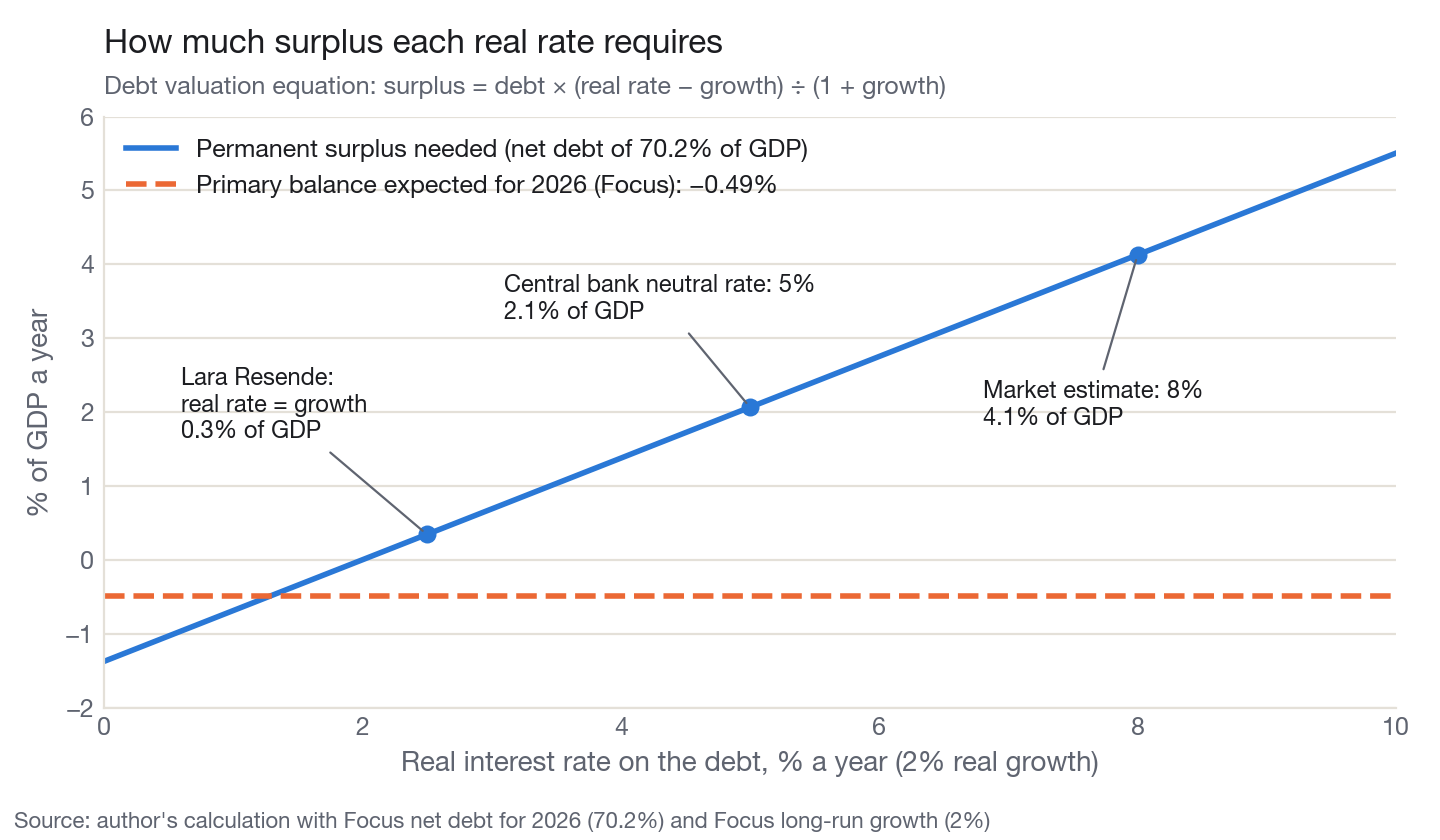
In the same essay, Lara Resende writes that in the long run “r is independent of i,” that is, the real rate does not depend on the nominal rate.2 To square that with his proposal, he needs today’s real rate to be above neutral and the neutral rate to be 2.5%. The first condition holds. The central bank itself describes monetary policy as contractionary over its entire projection horizon.7 The dispute is over the second: the level of the neutral rate, which no Selic decision can set.
On October 30, 2026, Brazil’s National Treasury was paying 7.3% a year above inflation on bonds maturing in 2050.9 That yield includes term and risk premiums, but it shows where the market puts the long-run real rate. Even with no risk premium at all, the central bank’s neutral rate would still be around 3.5%, a point above what the proposal assumes.8 In its September 2026 minutes, the central bank’s monetary policy committee, the Copom, lists weaker fiscal discipline and more directed credit among the factors that “have the potential to raise” the neutral rate.10 In the long run, under the neutrality Lara Resende invokes, a permanent Selic cut brings inflation down with the nominal rate, and the real cost of the debt settles at the neutral rate, above 2.5%.
In the transition, with the real rate below neutral, the proposal needs demand not to overheat. Cochrane accepts that in the short run lower rates may push inflation up before they bring it down.11 In the new Keynesian model, a lower real rate boosts consumption and investment and, with productive capacity unchanged, pushes up prices.
Lara Resende gets around the problem by saying the Phillips curve, which links how hot the economy runs to inflation, has become “practically flat.”2 My own estimate uses regional data for 2012 to 2026 from IBGE, the national statistics agency. It finds that areas with unemployment one point below normal had inflation 0.14 point higher in a basket of local services.12 Because the basket makes up about a quarter of the IPCA (Brazil’s consumer price index), the effect on the index is small, but it suggests the curve does slope. Comparing regions strips out the exchange rate and expectations, which are common to the whole country, so it leaves out precisely the channels through which a national Selic cut works.
A forced cut also weighs on the exchange rate, which Lara Resende proposes to hold up with reserves he puts at more than US$350 billion.2 On October 30, 2026, the market’s median forecast for 2027 inflation was already 4.76%, above the top of the target range.13 The short-term spike Lara Resende concedes, and calls transitory, would be unlikely to fade, since he himself writes that inflation is inertial and “tends to stay where it is.”2 Inflation that stays where it is does not fall with the Selic, contrary to what neutrality requires, and that leaves the real rate below neutral.
The 3% to 5.5% band Lara Resende proposes for the Selic has a ceiling equivalent to a real rate of 2.5%, given the 3% target. If the neutral rate really were that low, the band would be redundant, because the central bank would get there on its own in pursuit of the target. The band binds only when the central bank judges the neutral rate to be above 2.5%. In that case it holds the real rate below neutral, and inflation keeps rising for as long as the gap lasts, in the cumulative process Wicksell described.
Cochrane’s theory also requires that the government not spend what it saves on interest.11 To that end, Lara Resende proposes a National Fiscal and Monetary Council that would set fiscal targets four to five years ahead. Brazil already has fiscal targets, but Cochrane asks whether the country would really refrain from spending one more real.4 The spending cap can grow by up to 2.5% above inflation, and the 2027 cap already grows at that maximum, because revenue grew faster than the rule allows spending to match.14 The central bank’s Focus survey of October 30, 2026, projected GDP growth of 1.2% for 2027.14 Even with the fiscal rule met, permitted spending grows twice as fast as that, just when demand would call for a cut.
A spending cut works through two channels, and both come back to inflation.10 Through the demand channel, a government that spends less keeps total demand within productive capacity and makes room for the consumption and investment that lower rates encourage. The mix of income shifts toward private investment and away from public spending, which economists call crowding in.15 Fiscal adjustments usually reduce output in the short run, but those made by cutting spending cost less than those made by raising taxes.16 One reason is that central banks tend to cut rates more after spending cuts.
Through Cochrane’s channel, larger surpluses raise the present value that backs the debt, and in the fiscal theory that value is what anchors prices. So the risk premium and the neutral rate tend to fall together. The central bank only has to follow them down.
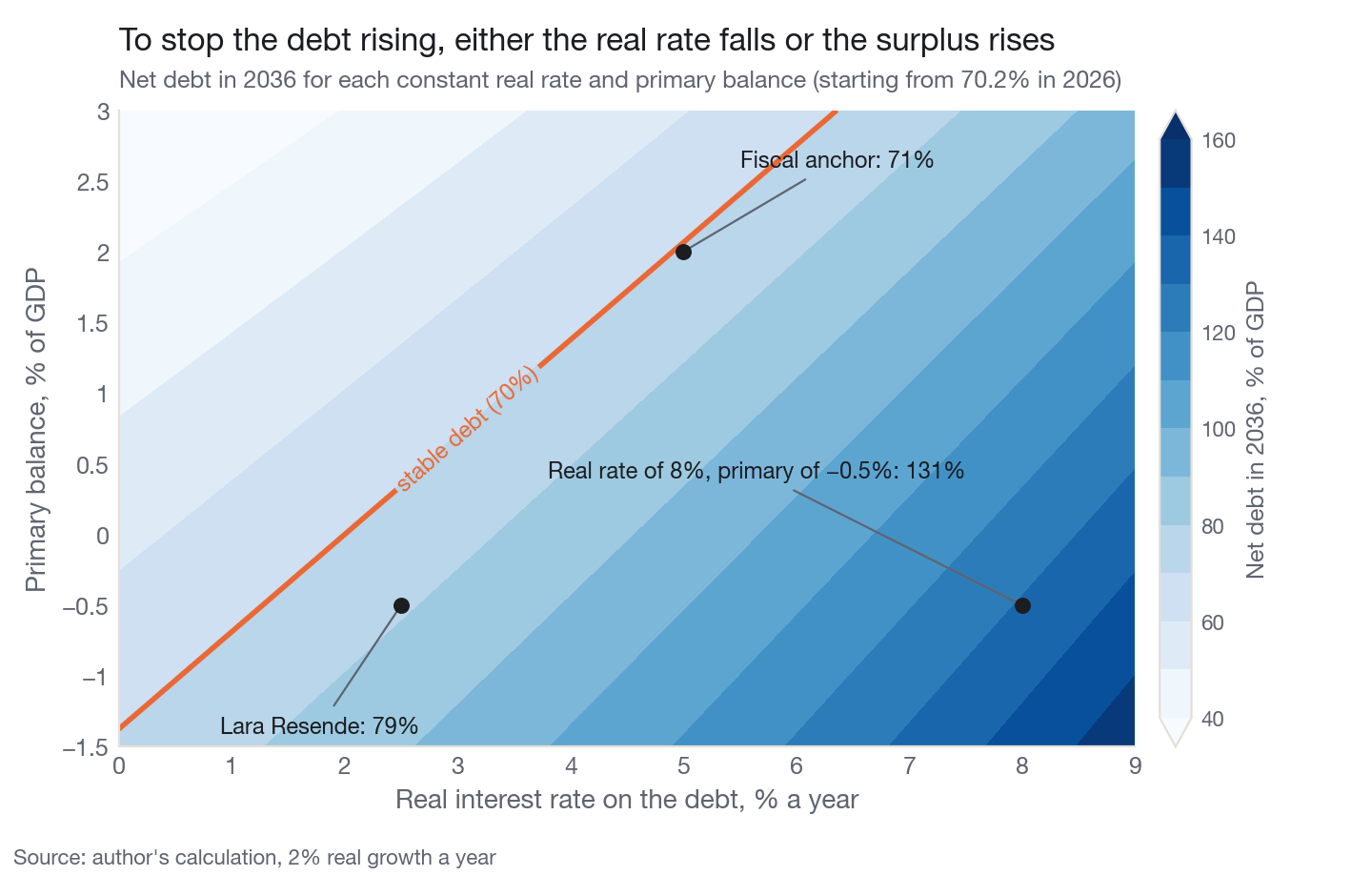
Because the case for the cut is about inflation, it holds even with a primary deficit of only 0.5% of GDP. The dose that demand requires depends on how much consumption and investment respond to rates, a response Cochrane considers smaller when the decline is slow and announced.11 The dose the debt requires to anchor prices can be calculated. At a 5% neutral rate, the primary balance has to rise by 2.6 points of GDP, about R$340 billion at 2026 prices.8 In my own simulation, debt in 2036 ends up at the level of the scenario Lara Resende promises, with inflation at target from 2030.8
Lara Resende accuses the central bank of preferring to persist in an error rather than admit it.2 Wicksell had already shown in 1898 that banks set only the market rate. Today’s real rate is indeed high. The part above neutral responds to inflation and expectations running above target.10 The rest, more than half, is a high neutral rate, and that also depends on the budget. “I Accuse” gets the size of the problem right and names the wrong culprit.
Footnotes
-
Émile Zola, “J’accuse…!”, L’Aurore, January 13, 1898. Knut Wicksell, Geldzins und Güterpreise, Jena, Gustav Fischer, 1898; English translation, Interest and Prices, Macmillan, 1936. ↩
-
André Lara Resende, “Eu Acuso: uma proposta para eliminar os juros absurdos,” Um Cético Esperançoso (Substack), September 25, 2026 (in Portuguese; quotations translated by the author). https://andrelararesende.substack.com/p/eu-acuso-uma-proposta-para-eliminar ↩ ↩2 ↩3 ↩4 ↩5 ↩6
-
NSC Total, “‘Pai do Real,’ André Lara Resende propõe cortar juros pela metade, chama atenção de Lula e é cotado para governo,” November 3, 2026 (in Portuguese). According to the report, Finance Minister Dario Durigan told Folha de S.Paulo that no “idea of fixing interest rates” was under discussion in the government. https://www.nsctotal.com.br/politica/pai-do-real-andre-lara-resende-propoe-cortar-juros-pela-metade-chama-atencao-de-lula-e-e-cotado-para-governo ↩
-
John H. Cochrane, “Fisher and Resende in Brazil,” The Grumpy Economist, November 3, 2026: “Or does the current real rate of interest also reflect a risk or default premium that will not so easily go away”; “Will Brazil really not spend one Real more, or tax one Real less?” The same post puts Brazil’s five-year CDS at 141 basis points. https://www.grumpy-economist.com/p/fisher-and-resende-in-brazil ↩ ↩2
-
Central Bank of Brazil, SGS series 5793 and 5727 (consolidated public sector borrowing requirement, primary and overall, % of GDP over 12 months), September 2026. https://www3.bcb.gov.br/sgspub/ ↩
-
Central Bank of Brazil, SGS series 432 and 13522, September 2026; the Copom cut the Selic to 13.75% at its 281st meeting (minutes, paragraph 18). https://www3.bcb.gov.br/sgspub/ ↩
-
Central Bank of Brazil, Relatório de Política Monetária (Monetary Policy Report), vol. 2, no. 3, September 2026, p. 80: the neutral real rate used in the baseline projections is 5.00%, below the expected real Selic, “which means monetary policy holds a contractionary stance over the entire projection horizon” (author’s translation). https://www.bcb.gov.br/content/ri/relatorioinflacao/202609/rpm202609p.pdf ↩ ↩2
-
Author’s calculation. The permanent surplus that backs the debt equals the debt times the gap between the real rate and growth, divided by one plus growth. Net debt of 70.2% of GDP at the end of 2026 and growth of 2%: Focus medians of October 30, 2026. At a 5% real rate the required surplus is 2.06% of GDP; the gap to the expected primary balance of −0.49% is 2.55 points, about R$340 billion on GDP of R$13.4 trillion over the 12 months to September 2026. The figure of around 3.5% is the 5% neutral rate minus the risk premium implied by Brazil’s five-year CDS of 141 basis points, cited by Cochrane (note 4); the CDS measures dollar risk and is only an order of magnitude. In the annual net-debt simulation, the adjustment scenario takes the Selic from 12% in 2027 to 8% (neutral plus target) in 2030, inflation from 4.5% in 2027 to the 3% target in 2030, and the primary balance from zero in 2027 to +2% of GDP from 2029; debt reaches 78.5% of GDP in 2036, against 79.3% in the scenario Lara Resende promises. The map holds the real rate and primary balance constant for ten years, so its levels differ. ↩ ↩2 ↩3 ↩4
-
National Treasury, Tesouro Direto, purchase rates on October 30, 2026: Tesouro IPCA+ 2050 at 7.27% a year above the IPCA, 2045 at 7.32% and 2035 at 7.88%. The rates include term and risk premiums as well as the expected real rate. Some market estimates of the neutral rate are higher still, such as the 8% estimated by Fabio Kanczuk, a former secretary of economic policy (InfoMoney, December 16, 2025). https://www.tesourotransparente.gov.br/ckan/dataset/taxas-dos-titulos-ofertados-pelo-tesouro-direto and https://www.infomoney.com.br/economia/taxa-juro-neutra-brasil-kanczuk-asa-selic-2026/ ↩
-
Central Bank of Brazil, minutes of the 281st Copom meeting, September 15 and 16, 2026, paragraph 8 (author’s translation): fiscal policy “has a short-term impact, mostly through stimulus to aggregate demand, and a more structural dimension, which can affect perceptions of debt sustainability”; “a fiscal policy that acts countercyclically and helps reduce the risk premium favors the convergence of inflation to the target”; “a weakening of the effort on structural reforms and fiscal discipline, the increase in directed credit and the uncertainty about stabilizing public debt have the potential to raise the economy’s neutral interest rate.” Paragraph 19 describes a scenario “marked by a significant increase in uncertainty, de-anchoring of expectations and high risks.” https://www.bcb.gov.br/publicacoes/atascopom ↩ ↩2 ↩3
-
John H. Cochrane, “More on lower rates,” The Grumpy Economist, September 4, 2026: “suppose you accept the neutral and stable long run of new Keynesian economics, so lower rates will eventually bring down inflation (fiscal policy held constant!), but there is a contrary movement in the short run”; “If Congress sees the lower interest costs and ramps up spending, the party is over.” In the same post, written before Lara Resende’s proposal, Cochrane notes that “[s]low and expected interest rate declines also give rise to much smaller output effects.” https://www.grumpy-economist.com/p/more-on-lower-rates ↩ ↩2 ↩3
-
Author’s estimate, not peer reviewed, using IBGE data (IPCA by area, SIDRA tables 1419 and 7060; unemployment from the PNAD Contínua survey, table 4099) with area and quarter fixed effects, which remove the effect of the Selic, the exchange rate and expectations, all common to the whole country. Twelve-month inflation of a basket of meals away from home, rent, condominium fees, repair labor, repairs, medical and laboratory services, personal services and courses, which accounts for 24.5% of the IPCA. The 95% interval runs from 0.06 to 0.21 point. Without rent and condominium fees, the coefficient falls to 0.08 and the interval includes zero; for 2022-2026 alone, there is no relationship. Method inspired by Jonathon Hazell, Juan Herreño, Emi Nakamura and Jón Steinsson, “The Slope of the Phillips Curve: Evidence from U.S. States,” Quarterly Journal of Economics, 2022. On why the curve looks flat in national data, see Michael McLeay and Silvana Tenreyro, “Optimal Inflation and the Identification of the Phillips Curve,” NBER Macroeconomics Annual, 2019. https://sidra.ibge.gov.br/tabela/7060 ↩
-
Central Bank of Brazil, Focus survey, median of October 30, 2026, for 2027 IPCA inflation (4.30% on October 22, 2026). The top of the target range is 4.5%. https://www.bcb.gov.br/publicacoes/focus ↩
-
Complementary Law 200 of August 30, 2023 (sustainable fiscal regime), art. 5: the primary spending cap grows by 70% of real revenue growth (50% if the primary balance target is missed), between 0.6% and 2.5% a year above inflation. For 2027 the cap grows 2.5% above the IPCA “since 70% of the real change in primary revenue, calculated at 5.36%, would exceed the maximum allowed” (Presidential Message on the 2027 Budget Bill, p. 121, author’s translation). 2027 GDP: Focus median of October 30, 2026, 1.198%. See also Brazil’s 2027 VAT reform, on the same budget. https://www.planalto.gov.br/ccivil_03/leis/lcp/lcp200.htm and https://www.gov.br/planejamento/pt-br/assuntos/orcamento/orcamentos-anuais/2027/ploa-2027/mensagem-presidencial.pdf/@@display-file/file ↩ ↩2
-
Brazil invested 16.8% of GDP in 2025, according to IBGE’s quarterly national accounts (SIDRA table 1846, gross fixed capital formation over GDP). By World Bank figures, gross capital formation was 17.0% of GDP in Brazil and 26.3% for the world in 2024 (indicator NE.GDI.TOTL.ZS). See also The comfort of stagnation. https://sidra.ibge.gov.br/tabela/1846 and https://data.worldbank.org/indicator/NE.GDI.TOTL.ZS ↩
-
IMF, transcript of the press briefing on the October 2010 World Economic Outlook, September 30, 2010, with Daniel Leigh, lead author of chapter 3, “Will It Hurt? Macroeconomic Effects of Fiscal Consolidation.” Leigh says fiscal consolidations “typically reduce growth” in the short term and that “governments that cut spending experience smaller contractions than those that raise taxes. And we found an interesting reason for that. Central banks typically cut interest rates more following spending cuts.” https://www.imf.org/external/np/tr/2010/tr093010.htm ↩